
Les coefficient de frottement de la bande transporteuse is a crucial parameter used to assess the performance and safety of conveyor systems. This coefficient determines the level of friction between the conveyor belt and the surface it interacts with, influencing the efficiency and reliability of the conveyor system. Understanding and testing this friction coefficient is essential for industries using conveyor belts for material transport, packaging, and other applications. In this article, we explore how to measure the coefficient de frottement of conveyor belts, focusing on ISO 21182 standards and the role of équipement d'essai du coefficient de frottement in this process.
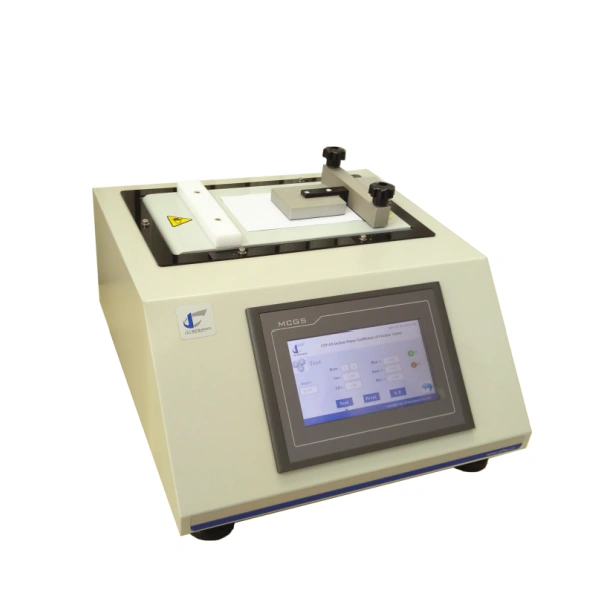
ISO 21182: A Standard for Conveyor Belt Friction Coefficient Testing
ISO 21182 specifies the test methods for determining both the static and dynamic coefficients of friction for light conveyor belts. These coefficients are critical for understanding how conveyor belts interact with materials they carry and how the belts perform under different conditions.
Key Aspects of ISO 21182
ISO 21182-2013 provides guidelines for the following:
- Dynamic Coefficient of Friction (μD): This coefficient measures the friction when the conveyor belt moves relative to the surface. The dynamic coefficient is influenced by factors like the material of the conveyor belt and the type of surface it interacts with.
- Static Coefficient of Friction (μS): This coefficient is measured when the conveyor belt is stationary, and the force required to initiate movement is calculated. This is also known as the “break-away force.”
Les dynamique et static coefficients of friction are essential in determining the suitability of a conveyor belt for specific applications, as they directly impact the efficiency, wear, and load-bearing capacity of the conveyor system.
Importance of Testing the Friction Coefficient of Conveyor Belts
Les friction coefficient of a conveyor belt directly affects several factors:
- Efficiency: High friction can result in more efficient material transport, but too much friction can lead to excessive wear and energy consumption.
- Safety: A proper friction coefficient ensures that the materials being transported do not slip, reducing the risk of accidents.
- Longevity: Understanding the friction coefficient helps prevent premature wear on both the conveyor belt and the rollers, ensuring the system’s long-term performance.
Testing the friction coefficient also allows manufacturers to optimize the material composition of the conveyor belt to meet industry standards and improve operational efficiency.
Équipement d'essai du coefficient de frottement
To measure the friction coefficient accurately, specialized testing equipment is used. The équipement d'essai du coefficient de frottement includes:
- Slide Angle Tester: This is a common device used to measure the friction angle of conveyor belts. The slide angle tester determines the angle at which a material will start to slide over a surface, which is directly related to the coefficient de frottement statique.
- Cellule de charge: A load cell is used to measure the frictional force during testing. It captures the force data during the test, which is essential for calculating the friction coefficient.
Les deux statique et dynamic friction can be tested using these devices, and the results help ensure that the conveyor belt will function optimally in its intended environment.
Procedure for Testing Conveyor Belt Friction Coefficient
The testing procedure involves the following steps:
- Test Piece Preparation: A sample of the conveyor belt is prepared according to ISO 21182, ensuring that the dimensions and surface conditions meet the required specifications.
- Conditioning: The sample is conditioned in a specific atmosphere, following the guidelines set by ISO 18573, to ensure that environmental factors do not affect the results.
- Friction Measurement:
- For dynamic friction: A test piece is placed under a constant normal force, and the frictional force is measured as the belt moves across a metallic panel at a defined speed. The dynamic coefficient is calculated using the formula:
μD=FNFD
où FD is the dynamic frictional force, and FN is the normal force. - For static friction: A test piece is subjected to a normal force, and the pulling force required to initiate movement is measured. The static coefficient is determined using the formula:
μS=FNFS
où FS is the static frictional force, and FN is the normal force.
- For dynamic friction: A test piece is placed under a constant normal force, and the frictional force is measured as the belt moves across a metallic panel at a defined speed. The dynamic coefficient is calculated using the formula:
- Recording and Calculating Results: The data is recorded, and the friction coefficients are calculated and expressed according to the ISO 21182 standards. Results are used to assess the belt’s performance under various conditions.
Benefits of Conveyor Belt Friction Testing
Test de la friction coefficient of conveyor belts offers several advantages:
- Improved Design: Manufacturers can optimize belt materials and surface finishes to enhance performance and reduce wear.
- Enhanced Safety: Understanding the friction helps ensure that the belt will perform safely under different load and speed conditions.
- Cost Efficiency: By testing the friction coefficient, businesses can avoid unnecessary wear and maintenance costs, ultimately reducing downtime and increasing productivity.
ISO 21182 and Industry Compliance
ISO 21182 plays a significant role in ensuring that conveyor belts meet the required friction standards for various applications, from material handling to packaging. Adhering to these standards ensures that conveyor belts operate efficiently, reduce wear, and maintain safety standards.
The Role of Friction Coefficient Testing for Conveyor Belts
Les coefficient de frottement de la bande transporteuse is a crucial factor for determining the performance, durability, and safety of conveyor systems. By using the équipement d'essai du coefficient de frottement, including slide angle testers et load cells, manufacturers can accurately measure the dynamique et static coefficients. Compliance with ISO 21182 standards ensures that the conveyor belt meets industry requirements for friction performance, offering safe and efficient operations.
Cell Instruments provides top-tier coefficient of friction testers, which help businesses assess and improve their conveyor belt systems. By using our advanced testing equipment, companies can optimize their material handling processes, ensuring safety and efficiency at every stage of operation.
 FR
FR  EN
EN  AR
AR  BG
BG  CS
CS  DA
DA  DE
DE  EL
EL  ES
ES  ET
ET  FI
FI  HU
HU  ID
ID  IT
IT  JA
JA  KO
KO  LT
LT  LV
LV  NB
NB  NL
NL  PL
PL  PT
PT  RO
RO  RU
RU  SK
SK  SL
SL  SV
SV  TR
TR  UK
UK