
COF of Plastic Film and Its Importance in Modern Packaging
The cof of plastic film is one of the most critical surface properties used to evaluate how plastic films behave during processing, packaging, transportation, and end use. In practical terms, it describes how easily one surface slides over another. For packaging engineers and quality control professionals, controlling the coefficient of friction of plastic film directly affects machinability, stacking behavior, sealing efficiency, and consumer handling.
As packaging materials continue to move toward thinner structures and higher production speeds, friction-related problems such as film blocking, poor feeding, or unstable stacking become more pronounced. A reliable and standardized approach to measuring plastic coefficient of friction helps manufacturers maintain consistent quality and reduce production risks.
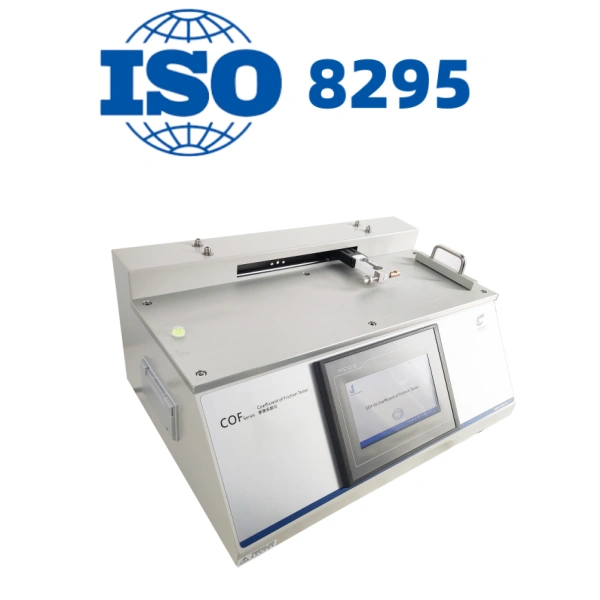
ISO 8295 and Standardized COF of Plastic Film Measurement
ISO 8295 provides an internationally accepted method for determining the static and dynamic coefficients of friction of plastic film and sheeting. This standard focuses on non-sticky films with thicknesses up to approximately 0.5 mm and is widely applied in quality control laboratories.
The method defined in ISO 8295 evaluates friction behavior under controlled conditions by sliding one film surface against another surface, which may be the same film or a different material such as metal. The test determines both the static coefficient of friction, which represents resistance at the onset of motion, and the dynamic coefficient of friction, which reflects resistance during steady sliding.
ISO 8295 emphasizes consistent contact time, normal force, test speed, and environmental conditioning. These parameters ensure that results from different laboratories remain comparable and meaningful.
What Does the Coefficient of Friction of Plastic Film Represent
The coefficient of friction of plastic film is calculated as the ratio of frictional force to normal force. While the numerical value appears simple, its implications are extensive. A low coefficient of friction allows films to slide easily, improving high-speed packaging efficiency. However, excessively low values may cause instability in stacked products. Conversely, a high coefficient of friction improves grip and stack stability but may create feeding or unwinding issues.
In real applications, the coefficient of friction plastic on plastic often differs from friction measured against metal or rubber surfaces. Film orientation, surface additives, aging, and environmental conditions all influence test outcomes. For this reason, standardized testing following ISO 8295 remains essential.
Typical Testing Principle and Equipment
A co-efficient of friction tester designed according to ISO 8295 usually consists of a flat horizontal table, a sled with a defined mass, and a drive mechanism that produces smooth relative motion. The test records the force required to initiate and maintain sliding between two surfaces under uniform pressure.
During testing, one specimen remains fixed on the test table while another specimen attaches to the sled. After a specified dwell time, the system initiates movement at a controlled speed. The peak force corresponds to static friction, while the average force during sliding represents dynamic friction.
Modern instruments improve repeatability by using precise force sensors, stable drive systems, and digital data acquisition. These features help laboratories achieve reliable results even when testing low-friction films.
Factors Affecting Plastic Coefficient of Friction Results
Several variables influence plastic coefficient of friction measurements. Slip additives incorporated into films may migrate to the surface over time, changing friction behavior. Surface contamination, fingerprints, or dust can significantly alter results. Film aging and storage conditions also affect measured values.
ISO 8295 addresses these factors by specifying specimen conditioning, handling precautions, and testing procedures. Laboratories often track film age to ensure that friction data reflects actual performance at the intended stage of use.
Why COF Testing Matters for Quality Control
In packaging production, uncontrolled friction can lead to line stoppages, inconsistent product appearance, or damaged goods. Measuring the cof of plastic film allows manufacturers to verify material consistency, compare suppliers, and adjust formulations or processing parameters.
For example, stable coefficient of friction plastic on plastic values help ensure smooth film unwinding and reliable stacking. In automated packaging lines, even small variations in COF may cause misfeeds or jams. Routine testing supports preventive quality management rather than reactive troubleshooting.
Cell Instruments Solutions for COF of Plastic Film Testing
Cell Instruments offers advanced co-efficient of friction tester solutions developed in line with ISO 8295 requirements. These systems provide precise control of test speed, normal force, and data acquisition, helping laboratories obtain repeatable and traceable results.
Beyond standard testing, Cell Instruments supports customized testing configurations, automation integration, and tailored solutions for special materials or application-specific requirements. This flexibility benefits packaging, food, medical, pharmaceutical, and quality inspection laboratories that require dependable friction data.
The cof of plastic film plays a decisive role in packaging performance and process stability. By applying standardized methods such as ISO 8295 and using reliable testing equipment, manufacturers can better understand and control friction behavior. Accurate measurement of the coefficient of friction of plastic film supports material optimization, improves production efficiency, and ensures consistent product quality. With professional testing solutions from Cell Instruments, laboratories gain confidence in their COF data and decision-making processes.
 EN
EN  AR
AR  BG
BG  CS
CS  DA
DA  DE
DE  EL
EL  ES
ES  ET
ET  FI
FI  FR
FR  HU
HU  ID
ID  IT
IT  JA
JA  KO
KO  LT
LT  LV
LV  NB
NB  NL
NL  PL
PL  PT
PT  RO
RO  RU
RU  SK
SK  SL
SL  SV
SV  TR
TR  UK
UK